What Are the Benefits of Under Cabinet Lighting?
When people think about kitchen lighting, the first thing that usually comes to mind is a ceiling light, recessed downlight, or pendant light above the island. But there is another layer of lighting that can make a surprisingly big difference: under cabinet lighting. At first glance, under cabinet lights may seem like a decorative extra. After all, why add another light when the kitchen already has ceiling fixtures? The answer becomes obvious the moment you try to chop vegetables under a wall cabinet with only an overhead light. Your own body blocks part of the light, the countertop becomes darker than expected, and suddenly you are trying to cut an onion while standing in your own shadow. That is exactly where under cabinet lighting becomes useful. Modern LED technology has also made cabinet lighting more flexible than it used to be. LED strips, light bars, puck lights, rechargeable cabinet lights, motion-sensor models, and smart lighting systems allow homeowners and designers to choose a solution based on the kitchen layout rather than simply installing whatever fixture happens to fit. So, what are the actual benefits of under cabinet lighting, and is it really worth installing? Let's take a closer look.
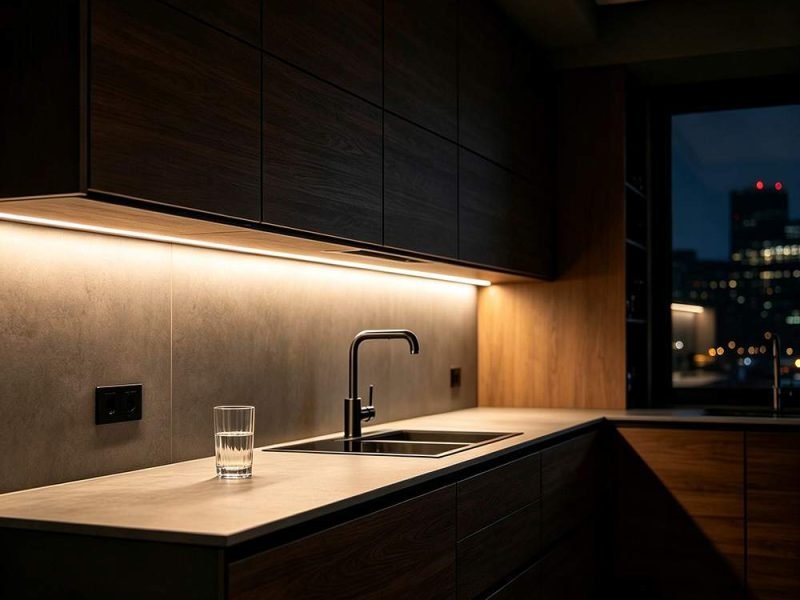
- Under Cabinet Lighting Puts Light Where You Actually Need It The biggest advantage of under cabinet lighting is also the simplest: it illuminates the countertop directly. Ceiling lights provide general illumination for the entire room, but they are not always ideal for detailed countertop work. When you stand at the counter, your head and upper body can block light coming from above. An under cabinet light works differently. Because it is mounted directly underneath the upper cabinets, the light is much closer to the work surface. This makes everyday activities such as chopping vegetables, preparing ingredients, reading recipes, making coffee, or cleaning the countertop easier and more comfortable. A recent discussion among homeowners on Reddit illustrates this practical appeal. Many users described under cabinet lighting as something they value less for decoration and more because it eliminates shadows while cooking and provides useful task lighting. Some even said they use the cabinet lights more frequently than their main kitchen lighting. That is an important distinction: under cabinet lighting is not simply another light source; it is task lighting designed around how people actually use a countertop.
- It Reduces Shadows on the Countertop Imagine preparing food at night with only recessed ceiling lights. The light comes from above and slightly behind you. As you lean over the countertop, your body naturally blocks part of the light. The result is a darker working area exactly where you need good visibility. Under cabinet lighting changes the direction of the light. Instead of relying entirely on overhead illumination, light is projected forward and downward onto the countertop. This can significantly reduce the shadows created by your body and upper cabinets. That is particularly useful for tasks requiring precision, including slicing, measuring ingredients, decorating food, or reading small labels. Bradco Kitchens & Baths similarly describes under-cabinet lighting as focused task lighting that helps reduce shadows and improve visibility during food preparation. For kitchen designers and lighting manufacturers, this is one of the strongest reasons to treat under cabinet lighting as part of the functional lighting plan rather than merely a decorative accessory.
- It Makes the Kitchen Feel More Comfortable at Night Not every trip to the kitchen requires turning on every light in the room. Maybe you want a glass of water at 11 p.m. Maybe someone is making coffee early in the morning. Or perhaps you simply want some low-level lighting while the kitchen is being used during a dinner party. Turning on bright ceiling lights can feel excessive in these situations. A dimmable under cabinet light provides another option. You can keep the main ceiling lights off and use the cabinet lighting at a lower brightness. The result is a softer layer of illumination that allows you to see the countertop without making the entire room feel like an operating theater. This is one reason modern cabinet lighting is increasingly designed with dimming, adjustable color temperature, remote controls, and motion sensors. In fact, homeowners discussing under cabinet lighting online frequently mention using dimmed cabinet lights as evening or nighttime lighting rather than simply using them for food preparation. So the same fixture can potentially serve two completely different purposes: Bright → task lighting Dim → ambient or nighttime lighting That versatility makes the investment more worthwhile.
- Under Cabinet Lighting Can Make a Kitchen Look More Expensive Let's move from function to aesthetics. Good lighting can change how materials look. A beautiful stone countertop, textured backsplash, wood cabinetry, or polished surface may look relatively flat under uniform ceiling lighting. Add carefully positioned under cabinet lighting, however, and those surfaces suddenly gain more depth. Light can emphasize the texture of a backsplash, reveal the pattern in natural stone, and create a visual separation between the upper cabinets and countertop. This is particularly effective in modern kitchens where the lighting itself is intended to remain visually discreet. The fixture doesn't necessarily need to become a design feature. In many cases, the best under cabinet light is the one you don't notice. You notice the result instead. A well-designed system can create a continuous line of light beneath the cabinets, producing a cleaner and more sophisticated appearance. This is also why LED strip lighting and slim LED light bars have become popular choices. Their low-profile construction allows them to hide underneath cabinets while providing relatively uniform illumination. AD Cola Lighting notes that modern options include LED strip lighting, puck lights, and linkable light bars, each suited to different cabinet configurations.
- LED Technology Makes Under Cabinet Lighting More Energy Efficient Older under cabinet lighting systems were often based on fluorescent or halogen technology. They could provide useful illumination, but they were generally less convenient than today's LED solutions. LEDs have changed the equation. Modern LED under cabinet lighting can provide high brightness while consuming relatively little electricity. LED fixtures also typically have a much longer operating life than traditional bulbs, which means less frequent replacement. For a homeowner, this means lower maintenance. For a kitchen designer, builder, hotel, restaurant, or cabinet manufacturer, it can also mean a more attractive long-term lighting specification. The exact energy consumption depends on the fixture, LED efficiency, brightness, operating hours, and power supply, so it is better to compare actual wattage and lumens rather than assuming that every LED product performs identically. Still, the basic advantage remains: LED technology allows manufacturers to build slim, bright, efficient cabinet lighting without requiring a large fixture.
- You Have More Design Options Than Ever One of the biggest changes in the under cabinet lighting market is the variety of available form factors. There is no single "best" under cabinet light for every kitchen. LED Strip Lights LED strips are particularly useful when you want continuous illumination across a long cabinet run. Because the strip can be cut or configured to different lengths depending on the system, it can work well for custom kitchen layouts. When combined with an aluminum profile and diffuser, an LED strip can produce a cleaner appearance while reducing visible LED hotspots. LED Light Bars Light bars provide a more structured alternative. They are typically rigid, slim fixtures designed for straightforward mounting underneath cabinets. They can be a good choice when you want consistent illumination without installing flexible tape lighting. LED Puck Lights Puck lights are compact, round fixtures that can work particularly well in smaller spaces or where you want individual pools of light. They can also be useful inside cabinets with glass doors or for accent lighting. However, because individual puck lights produce more localized beams, multiple fixtures may be needed to achieve the same continuous illumination as a strip or linear light. Rechargeable and Magnetic Cabinet Lights This is perhaps one of the most interesting developments for retrofit applications. Rechargeable cabinet lights eliminate the need to run new electrical wiring through existing cabinets. Magnetic mounting can also make the fixture easier to remove for charging or replacement. For renters, DIY users, or homeowners who don't want to open walls or modify cabinets, this can be an extremely practical solution.
- Motion Sensors Make Cabinet Lighting More Convenient A light that turns on when you need it sounds like a small feature. Until you have one. Motion-sensor under cabinet lighting can automatically activate when someone approaches the counter and switch off after a period of inactivity. This is particularly convenient when your hands are wet, dirty, or full of ingredients. You don't need to touch a switch. Motion sensors can also make cabinet lighting useful outside the kitchen. Similar concepts can be applied to wardrobes, closets, pantries, display cabinets, and other areas where people frequently need temporary illumination. For manufacturers, this has opened up another product-development direction: combining LED lighting + sensors + rechargeable batteries + magnetic installation + dimming into a single compact product.
- Adjustable Color Temperature Makes One Light More Versatile Not every kitchen needs the same type of white light. Warm white around 2700K–3000K can create a softer and more comfortable atmosphere, while around 4000K tends to provide a cleaner, more neutral appearance that many people prefer for detailed tasks. Some modern under cabinet lighting products therefore allow users to switch between different color temperatures. This is especially useful because the kitchen serves multiple purposes. During food preparation, you may want brighter, neutral-looking light. During dinner or late-night use, you may prefer something warmer and dimmer. A fixed light can only do one job particularly well. An adjustable system can adapt to the situation. AD Cola Lighting, for example, highlights under cabinet products offering multiple color-temperature and lumen settings, demonstrating how modern fixtures can combine task and accent lighting in one system.
- It Can Work as Part of a Layered Lighting System A common mistake in kitchen lighting is expecting one type of fixture to do everything. In reality, a well-designed kitchen often benefits from several layers. Ambient lighting provides general illumination. Task lighting illuminates work surfaces. Accent lighting adds atmosphere and highlights architectural details. Under cabinet lighting primarily belongs to the task-lighting layer, but with dimming and appropriate color temperature, it can also contribute to ambient or accent lighting. This layered approach is more flexible than simply installing brighter ceiling lights. Instead of one giant "ON/OFF" decision, you have different lighting levels for different situations. Cooking? Use task lighting. Eating dinner? Dim it. Cleaning? Turn everything up. Walking into the kitchen at night? Use low-level cabinet lighting. That's a much more comfortable way to use a kitchen.
- Under Cabinet Lighting Can Be a Valuable Upgrade for Renovations If you're remodeling a kitchen, under cabinet lighting is one of those features that can be difficult to appreciate until you have experienced it. Once installed correctly, it occupies very little visual space but can noticeably improve the room. Some homeowners on Reddit describe it as a feature they would not want to live without, particularly because of the combination of practical task lighting and improved appearance. Others mention that modern rechargeable and magnetic systems make retrofitting much easier than traditional hardwired installations. For new construction, hardwired systems can be integrated into the cabinetry for a clean finish. For existing kitchens, surface-mounted, plug-in, rechargeable, or magnetic solutions can provide a less invasive alternative. That means under cabinet lighting is no longer something you have to decide on only when building a new kitchen. What Type of Under Cabinet Lighting Should You Choose? The right choice depends on what you value most. Your Priority Recommended Option Continuous countertop illumination LED strip light Clean linear appearance LED light bar Small or individual lighting zones Puck light Easy retrofit installation Rechargeable cabinet light No-drill installation Magnetic cabinet light Automatic operation Motion-sensor LED light Flexible brightness Dimmable LED system Premium appearance LED strip + aluminum profile + diffuser Multiple lighting scenes Smart LED cabinet lighting For a new kitchen project, a wired linear or strip-based system can provide a very clean and integrated result. For an existing kitchen where installation complexity is the main concern, rechargeable magnetic cabinet lights can be much easier to introduce without significant renovation work. Are Under Cabinet Lights Really Worth It? So, are under cabinet lights necessary? Technically, no. Your kitchen will survive without them. But that's not really the right question. The better question is: What do you want your kitchen to do? If you only need basic room illumination, ceiling lights may be enough. If you want a kitchen that is easier to work in, more comfortable at night, visually more polished, and adaptable to different situations, under cabinet lighting offers several advantages at once. The most important benefit isn't that it makes the kitchen brighter. It makes the right area brighter. That difference matters. And thanks to modern LED technology, homeowners and B2B buyers now have far more choices than the old fluorescent cabinet lights of the past. From flexible LED strips and slim light bars to rechargeable magnetic fixtures and sensor-controlled products, under cabinet lighting can be designed around the space, installation requirements, and user experience rather than forcing the kitchen to adapt to the fixture. In other words, good under cabinet lighting doesn't simply add another light to your kitchen—it adds another layer of usability. For homeowners, that can mean a more comfortable kitchen. For designers, it creates another tool for shaping the space. And for lighting brands, cabinet lighting remains an attractive product category with plenty of room for innovation in sensors, smart controls, battery operation, optical design, and customization. That is probably why, despite all the changing kitchen design trends, under cabinet lighting continues to be one of those features people install and then wonder how they ever lived without.
A gaming setup, like my teen patti zone game corner, reveals how crucial even subtle illumination can be. Overhead lights might work for general areas, but when you’re focused on a fast-paced game, shadows and glare can ruin the experience of explore gaming platform . Just like under cabinet lighting eliminates dark spots in a kitchen, strategic lighting in your gaming space keeps everything visible without strain. The real game-changer is how teen patti zone game thrives under well-placed LED strips—just like cabinet lighting—highlighting the action while reducing eye fatigue during intense matches.