Are Battery LED Wall Lights Practical? A Complete Guide
Battery-powered lighting has changed the way people think about wall lighting. Traditionally, installing an LED wall light meant choosing a location near existing wiring, hiring an electrician, or dealing with visible power cords. Battery-powered and rechargeable wall lights remove much of that hassle. They can be installed almost anywhere, often without drilling into the wall or running electrical cables. But there is an obvious question: Are battery LED wall lights actually practical for everyday use? The answer is yes—but not for every application. A battery LED wall light can be an excellent solution for bedrooms, hallways, staircases, rental properties, artwork, reading areas, and decorative lighting. On the other hand, if you need a wall light to operate for many hours every day as a primary lighting source, a hardwired solution may still be more practical. Interestingly, real-world user experiences tend to reflect exactly this difference. In a recent Reddit discussion about rechargeable wall sconces, some users praised their easy installation and flexibility, while others complained that remembering to recharge them eventually became annoying. One user even described rechargeable lights as being useful in locations where electrical wiring was impractical, but admitted that the lights sometimes spent more time uncharged than in use. So let's take a closer look at where battery LED wall lights work—and where they don't.
What Is a Battery LED Wall Light? A battery LED wall light is a wall-mounted light that operates without a permanent connection to the building's electrical wiring. There are two common types. Rechargeable LED Wall Lights Rechargeable models use an integrated lithium-ion or similar rechargeable battery. When the battery becomes low, the light is connected to a charger, usually through USB-C, USB, or another charging interface. After charging, the light can be used wirelessly again. This design is becoming particularly popular because users don't need to continually purchase disposable batteries. Replaceable-Battery Wall Lights These lights use conventional batteries such as AA or AAA batteries. When the batteries run out, they can simply be replaced. This approach can be useful in locations where charging is inconvenient, but frequent battery replacement can become expensive or inconvenient if the light is used heavily. For occasional decorative lighting, however, replaceable batteries can still provide a very practical solution.
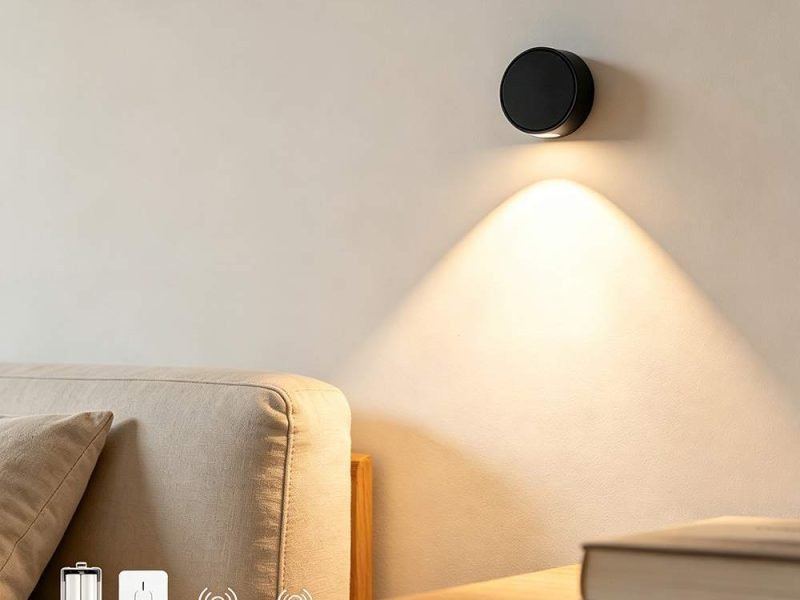
Why Are Battery LED Wall Lights So Popular? The biggest advantage is obvious: you don't need electrical wiring. A conventional hardwired wall light may require an electrical box, wiring inside the wall, installation work, and potentially an electrician. A plug-in wall light is easier, but the cable still needs to reach a power outlet. A battery LED wall light eliminates both problems. You can install a light on: A bedroom wall without existing wiring A rental apartment A hallway A staircase A closet A reading corner A gallery wall A temporary display A home office A guest room This flexibility is one of the strongest reasons people choose battery-powered lighting. One Reddit user explained that rechargeable sconces were particularly useful because there was no power available at the installation location and they did not want to bring in an electrician. Another user said rechargeable lights had become a useful backup during power outages. In other words, battery lighting solves a problem that traditional lighting cannot always solve easily: putting light exactly where you want it.
The Biggest Problem: You Have to Recharge It Of course, there is a trade-off. A hardwired LED wall light can remain available whenever you switch it on. A battery LED wall light cannot. Eventually, the battery needs to be recharged. This sounds trivial when you first buy the product. But how annoying it becomes depends heavily on how often you use the light. For example, a wall light used for 30 minutes before bed may only require charging occasionally. A light used for five or six hours every evening will obviously require much more frequent charging. This was one of the biggest concerns in the Reddit discussion. Some users said their rechargeable sconces were easy to live with and only needed charging every few weeks, while others said they eventually became tired of removing and charging them. One particularly useful pattern emerged from the discussion: Rechargeable wall lights tend to work best when the light is used for relatively short periods or only occasionally. That distinction is more important than simply asking whether battery-powered lighting is “good” or “bad.”
How Long Can a Battery LED Wall Light Run? There is no single answer because battery life depends on several factors. The most important ones are: Battery capacity: A larger battery generally stores more energy and can support longer operation. LED power consumption: A brighter light normally requires more electrical power. Brightness setting: Using a light at 30–50% brightness can dramatically extend runtime compared with operating it at maximum output. Sensor operation: Motion-activated lights may only operate for a few minutes at a time, which can greatly extend battery life. Color and lighting modes: RGB effects, high brightness, and other electronic functions can consume additional power. For this reason, manufacturers should avoid presenting battery life as a single universal number without explaining the conditions behind it. For example, “20 hours of battery life” could mean 20 hours at a relatively low brightness level rather than 20 hours at maximum output. When comparing products, buyers should look at both battery capacity and claimed runtime at specific brightness levels.
Are Battery LED Wall Lights Bright Enough? This is another important question. The answer depends on what you expect the light to do. A battery LED wall light can easily provide enough illumination for: Ambient lighting Accent lighting Decorative lighting Nighttime illumination Reading in some designs Artwork illumination Hallways Bedside use Closet lighting But it may not be the best choice when you need strong, continuous task lighting for a large area. A Reddit user raised a similar concern, questioning whether rechargeable wall sconces would provide enough light or battery life for more demanding applications. Another user said they loved their rechargeable sconces but would not use them as the primary light source. This leads to a simple rule: Use battery LED wall lights to supplement lighting rather than automatically treating them as a replacement for every hardwired fixture. For decorative and low-level lighting, battery operation can be a major advantage. For high-output commercial or task lighting, wired systems are often more appropriate.
Motion Sensors Make Battery Lighting More Practical If there is one feature that can make a battery LED wall light significantly more practical, it is a motion sensor. Consider a hallway light. If the light stays on for five hours every night, the battery will drain relatively quickly. But if a motion sensor activates the light for 30 seconds or two minutes whenever someone walks through the hallway, the same battery can potentially last much longer. This is why motion-activated battery lighting is particularly useful for: Staircases Hallways Closets Bathrooms Storage areas Entryways Nighttime navigation Wardrobes The Reddit discussion also included users who preferred rechargeable motion-activated lights because the convenience of automatic activation helped offset the need to recharge them. For product manufacturers, this suggests an important design direction: battery-powered + motion sensing can be more practical than battery-powered + conventional manual switching.
Magnetic Mounting Can Solve Another Problem Another useful feature is a removable magnetic mounting system. Instead of permanently fixing the entire light to the wall, the mounting bracket remains attached while the light module can be removed. When the battery is low, the user simply takes the light off the magnetic mount, charges it, and puts it back. This is considerably more convenient than removing screws or taking apart the fixture every time it needs charging. One Reddit user specifically praised rechargeable motion-sensing lights that attached magnetically because the light could simply be pulled off the mount and charged through USB-C. For a modern battery LED wall light, this is an excellent product-design concept. The charging process should be almost effortless. If users need a screwdriver every two weeks to access the battery, the product will quickly become frustrating.
Battery LED Wall Light vs. Plug-In vs. Hardwired So how does a battery LED wall light compare with traditional alternatives? Feature Battery LED Wall Light Plug-In LED Wall Light Hardwired LED Wall Light Installation Very easy Easy More complex Electrical wiring Not required Not required Required Visible cable None Usually yes None Installation cost Low Low Higher Portability Excellent Limited Very low Charging required Yes No No Long-term convenience Depends on usage Good Excellent Best for rentals Excellent Excellent Less suitable Best for decorative use Excellent Excellent Good Best for continuous use Limited Good Excellent Power outage backup Excellent No No This comparison makes the answer clearer. There isn't one universally “best” type of LED wall light. Instead, each technology solves a different problem.
When Is a Battery LED Wall Light a Good Choice? Battery-powered wall lighting is particularly practical when installing permanent electrical wiring would be expensive, inconvenient, or unnecessary. 1. Rental Properties Renters often cannot modify walls or install new electrical boxes. A battery LED wall light provides the appearance of a traditional wall sconce without permanently changing the property. 2. Bedrooms Battery-powered wall lights can work particularly well as bedside lighting. If the light is only used for reading or relaxing before sleep, the relatively short operating time can make battery charging manageable. 3. Hallways and Staircases These areas often don't require continuous illumination. Adding a motion sensor makes the system even more practical because the light only operates when someone needs it. 4. Decorative Lighting If the primary goal is creating atmosphere rather than illuminating an entire room, battery operation makes a lot of sense. The absence of visible cables also helps create a cleaner interior design. 5. Artwork and Displays A cordless wall light can illuminate artwork or decorative objects without requiring electrical wiring behind the wall. This makes battery-powered lighting attractive for temporary exhibitions, retail displays, showrooms, and residential decoration. 6. Areas Without Convenient Power Sometimes the problem isn't cost. There simply isn't an electrical outlet where you want the light. Battery power provides a practical workaround.
When Is Battery Lighting Probably Not the Best Choice? There are also situations where a hardwired LED wall light remains the better option. If the light is expected to operate for many hours every day, repeatedly charging the battery can become frustrating. This is particularly true for: Main room lighting Commercial corridors Restaurants Offices Retail stores High-traffic areas Security lighting Long-duration task lighting One Reddit commenter summarized the issue well by saying rechargeable sconces were suitable for places that are used infrequently, but became annoying when used for long periods. In these situations, the convenience of unlimited wired power generally outweighs the convenience of cordless installation.
What Should You Look for When Buying a Battery LED Wall Light? If you are considering a battery LED wall light, don't focus only on its appearance. Look at the entire system. Battery Capacity A higher-capacity battery can provide longer runtime, but it may also increase product size and weight. Actual Runtime Check whether the advertised runtime is measured at maximum brightness, medium brightness, or another setting. Charging Interface USB-C is increasingly convenient because many consumers already have compatible chargers. Charging Time A light that takes eight hours to recharge but only runs for three hours may become frustrating. Brightness Check lumens rather than judging brightness only from product photos. Dimming Adjustable brightness can significantly improve battery efficiency and user comfort. Motion Sensor For corridors, closets, and nighttime lighting, this can be one of the most valuable features. Mounting System Magnetic or easily removable designs make regular charging much easier. Battery Replacement For long-term product ownership, consider whether the battery can eventually be replaced. An otherwise functional LED light should not necessarily become unusable simply because its rechargeable battery has reached the end of its service life.
What Does the Reddit Discussion Tell Us? The most interesting thing about real-world user feedback is that there isn't a universal consensus. Some users strongly disliked rechargeable sconces because they found charging inconvenient. Others said they had used theirs for months with very little trouble. For example, one user reported using a rechargeable wall light for only 30–60 minutes each night and charging it roughly every few weeks. Another said their lights could run for around 28 hours on a dim setting. Meanwhile, other users reported that they eventually stopped using rechargeable lights because maintaining the charge became too annoying. This tells us something important: Battery lighting isn't necessarily impractical. Poorly matched applications are impractical. A light that needs to be recharged every few days is a very different product experience from a light that needs charging once every few weeks. Likewise, a decorative bedside light is very different from a wall light that needs to illuminate a busy restaurant for eight hours every night.
Are Battery LED Wall Lights Practical? The Final Answer So, are battery LED wall lights practical? Yes—but they are most practical when the application matches the strengths of battery power. If you want easy installation, no visible wiring, portability, and flexible placement, a battery LED wall light can be an excellent solution. They are especially useful for bedrooms, hallways, staircases, rental properties, decorative lighting, artwork, closets, and areas without convenient electrical wiring. However, if you need high brightness for long periods every day, hardwired lighting will usually provide better long-term convenience. The best battery LED wall lights are therefore not simply “wireless versions” of traditional sconces. They should be designed around the characteristics of battery power—with efficient LEDs, appropriate brightness, dimming, motion sensing, long battery life, convenient charging, and easy-to-remove mounting systems. For lighting manufacturers and brands, this is also where product development becomes important. A well-designed rechargeable LED wall light can turn battery charging from an annoying chore into a minor part of the user experience. Ultimately, the question isn't whether battery-powered wall lighting can replace wired lighting everywhere. It can't. The better question is: Where does the freedom of cordless lighting provide more value than the inconvenience of recharging? When the answer is clear, a battery LED wall light can be not just practical, but one of the easiest ways to add flexible lighting to a space.