What Are the Downsides of Smart Lighting?
Smart lighting has become increasingly popular in modern homes because it offers convenient control, adjustable brightness, automated schedules, and integration with smart home systems. With features such as smartphone apps, voice commands, and motion sensors, smart lighting can make everyday lighting more flexible and comfortable. However, smart lighting is not perfect. Higher upfront costs, connectivity problems, compatibility issues, and privacy concerns can make it less appealing for some users. Before investing in a smart lighting system, it is worth understanding its potential disadvantages and whether its benefits justify the additional complexity. In this article, we will explore the seven main downsides of smart lighting and explain what you should consider before choosing it for your home.
7 Disadvantages of Smart Lighting 1. Higher Initial Costs One of the most noticeable disadvantages of smart lighting is its higher initial cost compared with conventional lighting. A standard LED bulb or fixture generally provides basic on/off control and, depending on the product, dimming or color temperature adjustment. Smart lighting products may include additional components such as wireless communication modules, sensors, controllers, or specialized drivers, which can increase their purchase price. The cost can rise further when you install an entire smart lighting system rather than replacing a single bulb. You may need a compatible hub, smart switches, additional sensors, or other accessories to achieve the desired functions. For example, a simple smart bulb may be relatively affordable, but a system that combines app control, motion detection, scheduling, and voice control across multiple rooms can require a considerably larger investment. How to reduce this disadvantage: Start with the areas where smart lighting offers the most practical value, such as bedrooms, kitchens, wardrobes, or hallways. Choose products with the control functions you genuinely need instead of paying for features you may rarely use.
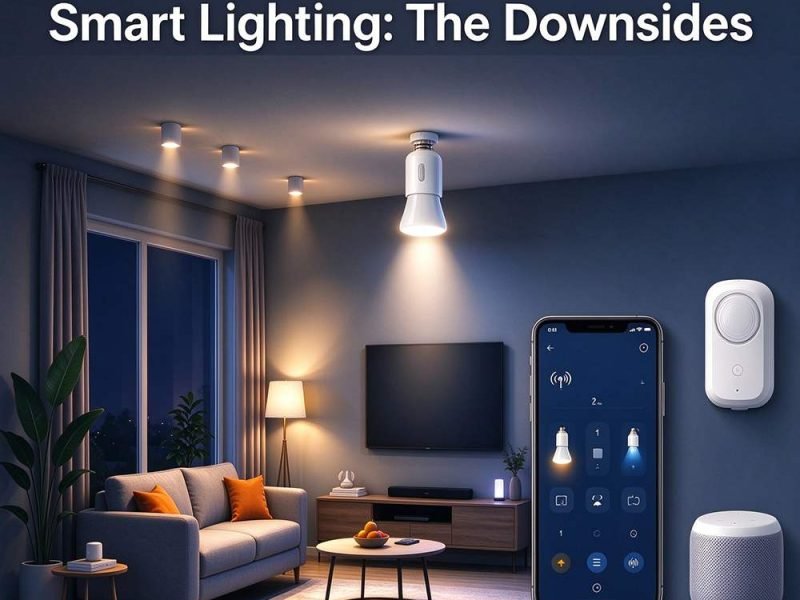
Dependence on Wi-Fi, Bluetooth, or Other Connections Another potential downside of smart lighting is its dependence on communication technology. Different smart lighting products use different control methods. Wi-Fi-enabled lights may depend on a stable home network for remote access, while Bluetooth products generally require the controlling device to be within communication range. Some systems use dedicated hubs or other wireless protocols to connect devices. When a network connection becomes unstable, certain functions may stop working as expected. For example, remote control through an app may become unavailable, voice commands may fail, or cloud-dependent automation may be interrupted. However, this does not mean every smart light stops working when the internet goes down. Many products retain basic manual operation, and some can execute schedules or automations locally without an internet connection. The exact behavior depends on the product design. How to reduce this disadvantage: Check what happens when Wi-Fi or internet access is lost. If reliability is important, choose smart lighting with physical switches, local control, or offline automation capabilities.
Compatibility Issues Between Devices and Platforms Smart lighting often works alongside other smart home devices, including speakers, sensors, switches, and home automation systems. However, not all products are compatible with one another. Some smart lights work only with a particular app or ecosystem. Others require a specific hub or communication protocol. Even when two products advertise support for the same smart home platform, certain advanced functions may not be available across both devices. For example, a smart bulb may support voice control through one ecosystem but offer limited integration with another. A smart switch may also require a particular wiring arrangement or a compatible lighting driver. These compatibility problems can become more complicated when homeowners purchase products from different brands over time. How to reduce this disadvantage: Before buying, confirm that the lighting products support your preferred smart home platform and control devices. If you plan to expand the system later, prioritize products that use widely supported standards and clearly document their compatibility.
Privacy and Cybersecurity Concerns Because smart lighting can connect to apps, wireless networks, and cloud services, it may introduce privacy and cybersecurity considerations that are not usually associated with conventional lighting. Depending on the product, its app, and the services it uses, a smart lighting system may process device information, usage patterns, account details, or automation data. Some products may also communicate with external servers to support remote access and advanced features. Poorly secured accounts, outdated firmware, or weak network security can increase the risk of unauthorized access. However, the level of risk varies significantly between manufacturers and product designs. It is also important to distinguish ordinary smart bulbs from more complex devices. A basic smart light without a microphone or camera presents a different privacy profile from a broader smart home device that collects additional information. How to reduce this disadvantage: Choose products from manufacturers that provide clear privacy policies and regular security updates. Use strong, unique passwords, enable multifactor authentication when available, and keep device firmware and associated apps updated. You can also review app permissions and disable unnecessary cloud or remote-access features.
More Complicated Installation and Maintenance Traditional lighting is usually straightforward to install and operate. Smart lighting can require additional setup, particularly when several devices must work together. Depending on the system, installation may involve pairing devices, configuring applications, connecting a hub, setting up automation rules, or adjusting permissions. Smart switches and hardwired fixtures may also require compatible wiring or professional installation. Maintenance can be more complicated as well. A conventional light may need only a replacement bulb, whereas a smart lighting product may require troubleshooting its app, wireless connection, controller, or firmware. Integrated smart fixtures can present another challenge. If the LED light source, driver, or control module is difficult to replace, repairing the product may be more expensive than maintaining a fixture with replaceable components. How to reduce this disadvantage: Consider installation requirements before purchasing. For long-term use, look for products with clear instructions, accessible replacement parts, reliable technical support, and control systems that are easy to configure.
Potential Reliability Problems and Unwanted Automation Smart lighting is designed to make lighting more convenient, but automation does not always behave as expected. Motion sensors may switch lights on when someone passes nearby or fail to activate when movement is outside their detection range. Automated schedules can also become inconvenient when household routines change. Voice control may misinterpret commands, while app-based control can be less immediate than using a physical switch. Sensor performance depends on several factors, including sensor technology, installation position, detection angle, environmental conditions, and product settings. For instance, PIR motion sensors detect changes in infrared radiation and are commonly used for occupancy-related lighting. Microwave sensors use reflected electromagnetic waves to detect movement and may respond to movement beyond the intended area if their sensitivity and placement are not properly adjusted. These limitations can lead to unnecessary lighting, interruptions, or frustration if the system is poorly configured. How to reduce this disadvantage: Choose the appropriate control method for each application. Adjust sensor sensitivity and delay settings, test detection coverage before final installation, and retain manual control when convenient operation is important.
Long-Term Costs and Product Obsolescence Although smart lighting can help reduce unnecessary energy use, it does not automatically guarantee lower overall costs. Some smart lighting products consume a small amount of standby power to maintain wireless communication and remain ready for commands. The amount varies by device, and it may be negligible for an individual light, but it can accumulate across a large installation. More importantly, savings depend on how the system is used. Automated switching and occupancy detection may reduce wasted lighting, but complicated features do not necessarily produce meaningful savings if lights are already used efficiently. There is also a long-term support issue. If a manufacturer discontinues an app, changes its cloud service, or stops providing updates, some connected features may become unavailable. The light may continue to operate manually, but its original smart functions could be reduced. How to reduce this disadvantage: Evaluate energy efficiency, expected service life, warranty coverage, software support, and replaceable components. Where possible, choose products that retain basic lighting functions without relying entirely on a cloud service.
Is Smart Lighting Worth It Despite These Disadvantages? For many households, smart lighting remains a worthwhile investment, provided the system is selected according to actual needs. Factor Smart lighting Conventional lighting Initial cost Generally higher Generally lower Remote control Often available Usually unavailable without additional equipment Automation Supports schedules and sensor-based control, depending on the product Limited without separate control devices Connectivity May depend on wireless communication Usually independent of a network Setup May require app configuration or pairing Typically simpler Privacy considerations Depends on connectivity and data collection Usually fewer connected-device concerns Long-term flexibility Depends on compatibility and software support Often straightforward to maintain Smart lighting is particularly useful when you want to automate everyday tasks, control lights remotely, adjust brightness or color temperature, or integrate lighting into a broader smart home system. On the other hand, conventional lighting may be a better choice when low upfront cost, simple operation, minimal maintenance, and independence from wireless networks are your main priorities. A practical middle ground is to use smart lighting selectively. For example, you might install smart lights in frequently used rooms while keeping conventional lighting in storage areas or spaces where advanced control provides little benefit.
Final Thoughts The main downsides of smart lighting include higher upfront costs, connectivity dependence, compatibility challenges, privacy concerns, more complicated maintenance, potential automation problems, and uncertainty about long-term software support. Most of these disadvantages can be managed by choosing reliable products, checking compatibility, understanding offline behavior, and selecting control features that solve real problems. Ultimately, the best lighting system is not necessarily the one with the most advanced technology. It is the one that delivers the right balance of convenience, reliability, energy efficiency, cost, and ease of use for your home.